Winch-out and recovery in Boulder: what happens when you call
Boulder Towing Company recovers cars from snowbanks, ditches and canyon shoulders at any hour, in Boulder and the towns and canyons around it. A recovery is decided on the call: what is holding the car, what it will take to free it, and whether it will drive away afterward.
If anyone is hurt, or the car is sitting blind around a bend, call 911 first; only an officer can close a lane. Then four questions decide which truck rolls and what rides on it.
- Where, exactly. A cross street in Martin Acres, a mile marker on CO 119, a pullout on Flagstaff Road.
- What is holding it, and how far off the pavement. Two wheels in a plow ridge is a strap and a few minutes; a car down the slope below a shoulder is a full line run out and a staged pull.
- Whether it is upright. A car on its side or roof is rolled back onto its tires before anything else, with a different set of straps.
- What the car is. Make, model, and whether it is all-wheel drive, four-wheel drive or electric, which decides how it rides home.
The quote covers the whole job, and the arrival window comes with it. If the car will not drive away afterward - no start, no steering, a wheel folded under - we price an emergency tow after the recovery on the same call.
What a recovery costs in Boulder, and why it is quoted differently
Hook, load, drive, unload: a straight tow has the same four steps every time. A recovery has no fixed number of steps until the line is loaded. The cost page walks through why recovery is quoted differently from a straight tow; here is what we are pricing.
- Time on scene. Shoveling out the tires, finding an anchor, pulling a few feet and re-rigging: no line on the quote moves as much, and a canyon job adds the drive.
- Rigging. The plain pull is one winch line to a frame hook. A car that is deep, or off the truck's line, needs a snatch block to double the pull or turn the angle.
- Whether a tow follows. If the car will start and steer, the job ends at the pavement. If not, the ride to a shop is its own line on the same quote.
Colorado draws the same line. The Public Utilities Commission caps what a tow company may charge for a nonconsensual tow - a private-property impound or a tow ordered by law enforcement - under 4 CCR 723-6, and it prices a law-enforcement-ordered tow and recovery by the hour, not as a flat job.
A recovery you call for yourself is consensual, and the PUC does not cap it; it is priced by the quote you agree to. Colorado does require the carrier to disclose all rates and charges before the tow, including estimated mileage, so the call ends with one total for the pull and the ride home.
What a winch-out involves on Boulder's roads: snow, canyon shoulders, ditches and crashes
Snowbanks and plow ridges
Boulder's normal season is 89.71 inches of snow on the NOAA figures, heaviest in February, March and April, when upslope storms push Gulf moisture up against the foothills as heavy, wet snow; the March 2021 storm put 15 to 21 inches on and around the city. Cars slide on the turn into a side street, misjudge the curb under a drift, or nose into the ridge a plow left across a driveway.
Most snowbank pulls are short: the car comes back out the way it went in, over snow its own tires have packed, on a recovery strap if it is sitting on top or on the winch line if it has dug in. The wheels stay still: a spinning tire polishes the snow into ice and sinks the car further, so the first thing we ask on the phone is that you take your foot off the throttle.
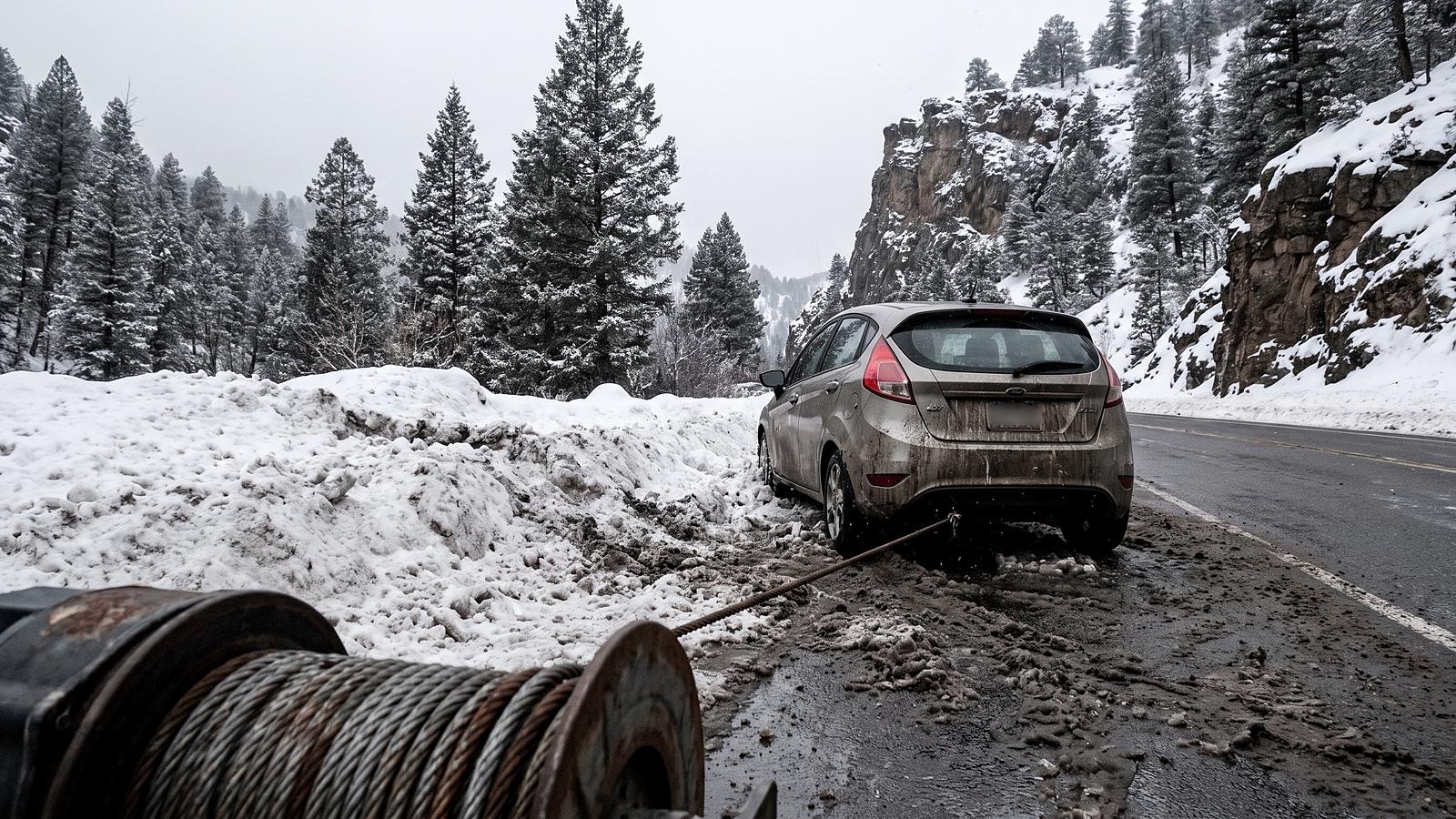
Canyon shoulders and drop-offs
Boulder Canyon is CO 119 from Canyon Boulevard to Nederland, 17 miles west at 8,235 feet, with grades up to 10 percent. Flagstaff Road climbs nine miles of hairpins to Gross Reservoir with slim to no shoulders; Magnolia Road averages 9.1 percent and turns to dirt past the top of the climb. Up here a car goes off the edge of the pavement, and then down.
A canyon recovery is about the anchor and the angle first. The truck sets up on the pavement, uphill where the road allows and chocked, with the line on a frame point so the car comes back up the way it went down, in stages. A car that has gone too far down for a light-duty truck to bring up safely is a job we tell you about on the phone. Rock comes down too - in April 2021 five truck-sized boulders closed CO 119 in the Narrows - so say so if the road is closed behind you.
Ditches and soft shoulders
Outside the city grid the curb ends. The Diagonal, CO 7 along Arapahoe and Baseline, and the roads across the open space toward Gunbarrel have a shoulder and then a ditch, and in a spring melt the grass edge is mud to the hub. A car that drops a wheel in tips toward the ditch, and throttle digs the second wheel in beside the first.
With the front wheels in, the car comes out backward, nose lifted over the lip; a car hung up on the edge gets one end lifted first so the floor pan never drags. The strap goes on the tow points or around a wheel, never an axle, a control arm or a bumper, and a ditch full of meltwater earns the air intake a look before anyone tries the key.
After a crash
A crash changes the order of the work: a car on its side or roof is rolled back onto its wheels first, with the straps placed so the tires take the landing, not the suspension; then it is pulled out of the lane; the tow is last. A bent knuckle or a folded wheel means the car cannot roll, so loading a damaged vehicle on a flatbed means pulling it up the tilted deck on the line.
While the truck sits on the shoulder with its yellow lights on, Colorado's Move Over law tells passing drivers to move a lane apart or slow down; wait behind the guardrail anyway, because not everyone does.
While you wait: what not to do, and when a winch-out is the wrong call
Many of the dents and torn bumpers we find on a recovery were not there when the car left the road; they came from the trying before the call.
- One try, then stop. Easing back and forth in the car's own tracks with the wheel straight can free a car that is barely stuck. If the tires spin and the car stays put, every spin after that sinks it further.
- No strap on a tow ball. A hitch ball carries a trailer's steady weight, not a snatch; one that shears off goes wherever a stretched strap sends it, and bumpers and control arms fail the same way.
- Out of the lane, then away from it. On US 36, the Diagonal or Foothills Parkway, leave by the door away from traffic and wait behind the barrier; on a canyon road with no shoulder, walk uphill and well off the pavement.
Under load a winch cable is a stretched spring; a hook or strap that fails flies back along its own line faster than anyone can react. While we pull, stand off to the side and uphill, never between the car and the truck, and keep everyone off the road until the cable is slack.
For an all-wheel-drive, four-wheel-drive or electric car the pull is only half the decision; the other half is the ride home. Subaru's guide warns that improper towing may damage the all-wheel-drive system and says to use a flatbed; Tesla says a Model 3 must never be moved with its tires where they can spin. Those cars leave on a deck, and so does anything with a folded wheel, bent steering or water above the floor.
And sometimes a winch is not the job at all: a car that will not start on a cold morning is a jump, and a car on a flat tire on a firm shoulder is a tire change. Tell us what happened and we bring the right thing.
Recovery across Boulder, the canyons and the neighboring towns
Recovery calls come from every part of Boulder - downtown and Pearl Street, The Hill, Chautauqua, Table Mesa, Martin Acres and Shanahan Ridge, out to Gunbarrel, ZIP codes 80301 through 80305 - and from the highways: US 36 from the Table Mesa Park-n-Ride through 28th Street, Foothills Parkway, the Diagonal, CO 93 toward Golden and CO 7 along Arapahoe and Baseline.
In the canyons we go up CO 119 through Boulder Canyon to Nederland and on toward Eldora, 21 miles and about 35 minutes from town, and up Flagstaff, Magnolia and Sugarloaf; give us the mile marker or the last pullout you passed.
Everything here is part of Boulder's towing and recovery service, and the service area runs past the city line: Gunbarrel about 7 miles, Superior 8, Louisville and Niwot 9, Lafayette 11, Broomfield 13, Erie 14, Longmont 15, Lyons 16, Nederland 17 and Golden 20 by road. Distance changes the quote, not the rigging.
Frequently asked
What is a winch-out?
A winch-out is a recovery done with the truck's winch line rather than the truck's own movement. Boulder Towing Company anchors the truck on firm ground, runs the cable to a proper hook point, and brings the car back to the pavement with a slow, controlled pull. A tow may follow or not; we tell you which on the call.
My car slid into a snowbank on Flagstaff Road - can Boulder Towing Company pull it out without damage?
Usually, yes. Boulder Towing Company brings a snowbound car out along the tracks it made going in, with the strap or winch line on the tow points or the frame, never the bumper, slowly enough to stop if anything binds. On Flagstaff's grade we chock the truck and pull uphill in stages. What we cannot fix is damage done before we arrive: a car spun down onto its belly pan, or a bumper pulled loose by a stranger with a strap.
Do you recover vehicles after an accident?
Yes, at any hour. Boulder Towing Company recovers crashed vehicles in three steps: back onto the wheels if it rolled, clear of the lane, then onto the flatbed by winch if it cannot roll. An officer's order makes it a law-enforcement-ordered tow under the Colorado PUC's hourly maximum for tow and recovery; a call from you is consensual, with one quote for the recovery and the tow.
What is the 80/20 rule in towing?
The 80/20 rule is a trailering rule of thumb, not a regulation: load a trailer to no more than about 80 percent of what the tow vehicle is rated to pull, keeping the rest as margin for grades and braking. Boulder Towing Company works from the tow rating and GVWR of its own trucks, and if a job is beyond a light-duty truck, we say so on the call.
Can you pull a car out of a flooded underpass?
Yes, once the water has dropped enough for the truck to reach the car and see what it is sitting on. Boulder Towing Company winches it to dry pavement and sends it to a shop on a flatbed, wheels off the ground and the key untouched. Do not try to start it; if water reached the intake, turning it over can do more damage than the flood did.